
FAQS
Find it faster
Check the menu first.
Find answers about registration, equipment, packet pickup, transition, the swim course, race rules and race morning. The main menu and its dropdowns lead to complete pages for each subject. Use those pages for full details, then check the frequently asked questions below for quick clarification.
Frequently Asked Questions
Registration & Policies
Select a QuestionHow do I know if I am registered?
Sign in to your RunSignup account, open your profile, and look under Upcoming Events. Select Manage Registration beside the Texas City Triathlon, Duathlon & Aquabike.
You may also search the event’s participant list or resend your registration confirmation from your RunSignup account.
What is the minimum age to participate?
The event minimum age is 12 years old. Anyone considered a minor by USA Triathlon must have authorization from a parent or legal guardian.
Race management may contact the parent or guardian after registration to discuss the athlete’s experience, preparation, supervision, or any additional safety information.
Can I receive a refund or transfer my entry?
No refunds are offered. Individual registrations may not be transferred to another athlete. Relay teams may change teammates according to the event’s relay policies.
Can I defer my registration until next year?
Yes. Complete the deferral yourself through RunSignup by the end of the day on Thursday, two weeks before race morning.
When registration opens the following year, contact the race to activate your deferral. You will receive a personal link to re-register at 30% of the then-current entry fee. You are not registered until that new registration and payment are completed.
Does the race offer registration insurance?
Optional registration insurance may be offered in the registration checkout through a third-party provider. It is not provided or administered by the race or RunSignup.
Review the provider’s terms before purchasing. Follow the instructions in the separate confirmation email if you need to submit a claim. Insurance cannot be added after registration is complete.
How do I change my registration information?
Sign in to RunSignup and select Manage Registration. Available options may include updating personal information, question responses, giveaway size, add-ons, or event selection.
When is the deadline to make registration changes?
Cycling jersey size changes must be completed approximately six weeks before the race. Most other permitted registration changes must be completed approximately two weeks before race day.
Options may disappear from RunSignup once their applicable deadline passes.
Packet Pickup & Race Numbers
Select a QuestionWhen and where is packet pickup?
Packet pickup dates, hours, location, identification requirements, and optional delivery methods are listed on the dedicated Packet Pickup page.
Can someone else pick up my packet?
Yes. The person collecting your packet must have:
- Your registration QR code.
- A copy or photograph of your government-issued photo ID.
- Written permission from you by handwritten note, email, or text message.
Is race-morning packet pickup available?
Race-morning pickup is available only to athletes who purchased the add-on in advance. It is not a general race-morning pickup option.
Check the Packet Pickup page for the location, operating hours, arrival deadline, and instructions.
What is included in my race packet?
Depending on your event, your packet includes:
- One race-issued swim cap for Triathlon and Aquabike.
- Helmet and bicycle identification stickers.
- One run bib.
- Your selected event cycling jersey or unisex event shirt.
Check your packet before leaving pickup and report any missing items immediately.
Where do I place my numbers and stickers?
- Swim cap: Wear the race-issued cap during the swim. Do not write your race number on it.
- Helmet sticker: Place it on the front center of your helmet.
- Bicycle stickers: Attach them so your number is visible from both sides of the bicycle.
- Run bib: Wear it during the run with the number facing forward and unobstructed.
Where do I receive and wear my timing chip?
Your chip and ankle strap will be attached to your assigned bicycle rack position in transition on race morning.
Thread the strap securely through both chip openings and wear it on your left ankle to help keep it away from the bicycle crank. A proper fit should allow approximately two fingers between the strap and your ankle.
Triathlon and Duathlon: Return the timing chip and ankle strap immediately after crossing the finish line.
Aquabike: Return the timing chip and ankle strap to your assigned rack position before leaving transition. If needed, you may instead take them directly to the timer at the main finish area.
Equipment, Rules & Transition
Select a QuestionWhat type of bicycle may I use?
A road, triathlon, hybrid, mountain, or other standard bicycle may be used if it is safe, roadworthy, and in proper operating condition.
The bicycle must have working brakes and securely plugged handlebar ends. Motorized bicycles and e-bikes are not permitted. Unusual or adaptive equipment must be approved in advance.
What equipment am I required to provide?
- A safe, operational bicycle.
- An approved, properly fitting bicycle helmet.
- Shoes for the bicycle and run segments.
- Appropriate athletic clothing or swimwear.
- Goggles are not mandatory but are strongly recommended for Triathlon and Aquabike athletes.
The race provides identification numbers, a swim cap when applicable, and a timing chip with ankle strap.
Are headphones, earbuds, or speakers allowed?
No. Headphones, earbuds, bone-conduction headphones, smart helmets, personal speakers, and similar audio equipment are not permitted during the event.
Athletes must remain able to hear officials, volunteers, emergency vehicles, other athletes, and changing course conditions.
May I carry or use my phone?
You may carry a phone or wearable device for passive tracking, navigation, or emergency use. It may not be used in a distracting manner.
Do not make calls, send messages, use social media, play music, take photographs, or use two-way communication while actively competing, except when contacting emergency authorities.
Are wetsuits allowed?
- 60.7°F–78.0°F: Wetsuits are permitted and athletes remain eligible for applicable awards.
- 78.1°F–83.9°F: Wetsuits may be worn, but the athlete is not eligible for age-group awards or USAT rankings.
- 84.0°F and above: Wetsuits are prohibited.
- 60.6°F and below: Wetsuits are mandatory, subject to any additional safety decision.
Wetsuit shorts and other neoprene or rubberized garments are treated as wetsuit equipment. The official determination is based on the race-morning water temperature—not an online reading or forecast.
How do I find my assigned place in transition?
Your assigned race number will be sent before race day. On race morning, locate the rack row containing your numbered position. That is where you must rack your bicycle and place your gear.
Keep all equipment inside your assigned area and do not move or interfere with another athlete’s bicycle or equipment.
How should I set up my transition area?
Keep your setup compact, organized, and entirely inside your assigned space. Place necessary shoes, helmet, race bib, towel, and other approved equipment beside your bicycle without blocking the travel lane.
There is no pre-race bicycle check-in. Bring your bicycle and equipment with you on race morning.
Swim, Course & Race Day
Select a QuestionHow deep is the swim course?
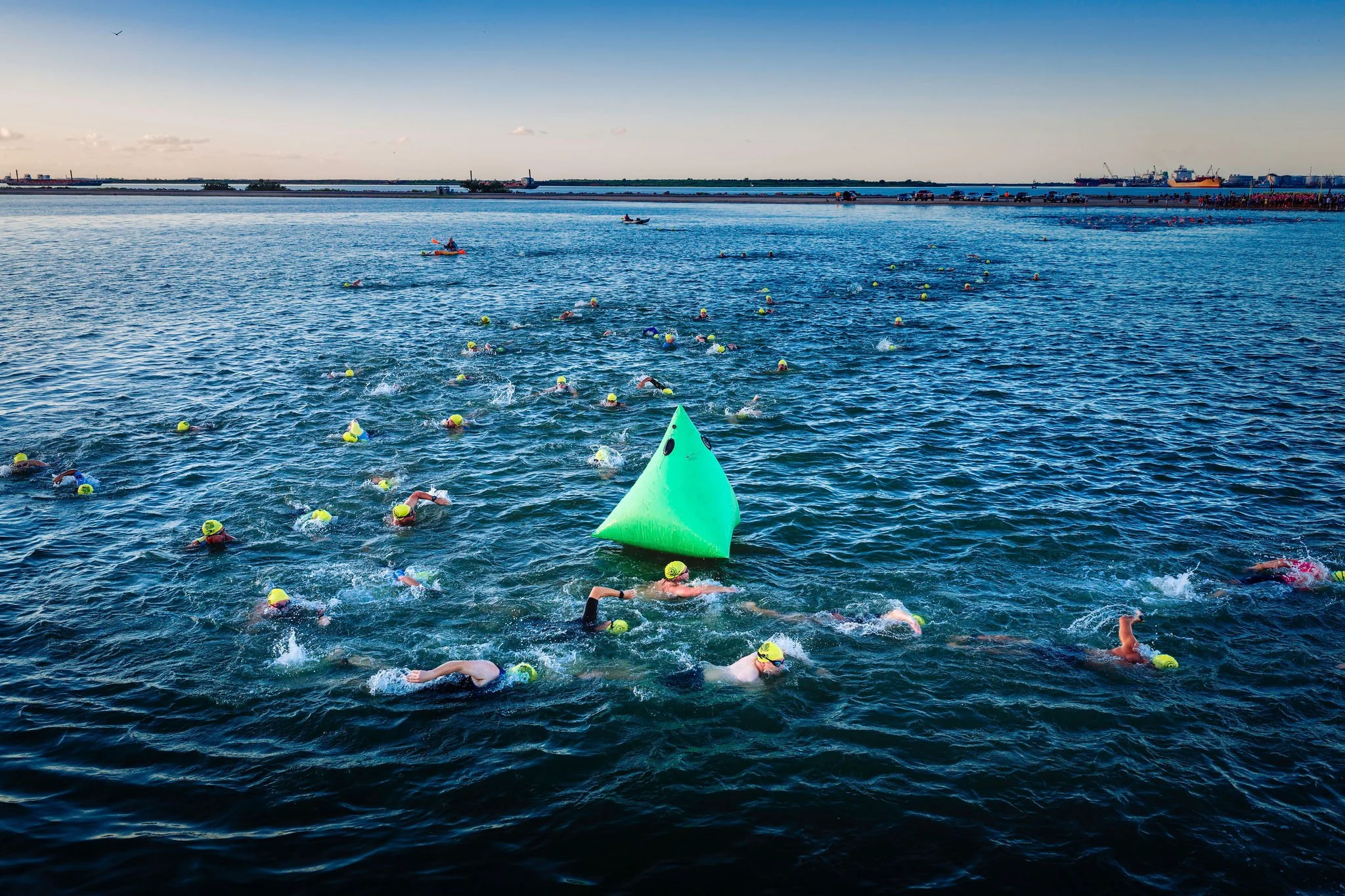
The swim begins by running or walking into gradually deepening water. Depending on the tide, many athletes can touch the bottom for approximately the first 100–125 meters.
Between the turn buoys, the water is approximately 7–10 feet deep and will be over most athletes’ heads. The water gradually becomes shallower during the return to shore.
How far is the swim exit from transition?
The distance from the swim exit to the bicycle racks in transition is approximately one-quarter mile.
The route begins on a soft sand path and continues onto the paved road leading to transition.
May I leave shoes at the swim exit?
Yes. Athletes concerned about the quarter-mile trip to transition may leave inexpensive shoes or sandals at the swim exit.
Use shoes you are willing to discard and do not use your primary run shoes. Any shoes remaining after the event may be discarded or donated.
What time does transition open and close?
Transition opens on race morning at the time listed on the official schedule and closes before competition begins. Arrive with enough time to park, reach transition, collect your timing chip, rack your bicycle, organize your equipment, and leave the transition area before it closes.
Is there a race cutoff time?
The event concludes at 11:00 a.m. Athletes must be able to complete their event by that time.
Account for your individual start or swim-wave time when estimating whether you can finish before the event concludes.
When may I retrieve my bicycle after racing?
Limited bicycle claiming begins at the time posted on the schedule. While cyclists remain on the course, small groups may be permitted into transition, so the line may move slowly.
Transition fully opens for bicycle claiming after the final cyclist has begun the run. Please be patient and follow the directions of transition staff.
Be prepared to show your run bib so staff can match it to the numbers on your bicycle and helmet.
Where should I park on race morning?
Use legal street parking along 9th Street and the designated nearby numbered streets and school areas west of Bay Street. Do not park on Bay Street, in Bay Street Park, on Skyline Drive, or on the Texas City Dike.
What happens if there is severe weather?
Weather and course conditions are continually monitored. The event may be delayed, shortened, modified into a duathlon or run-only event, or cancelled when conditions are unsafe.
Decisions may consider lightning, flooding, wind, heat, water temperature, water quality, waves, currents, and emergency access. Athlete safety takes priority.
Where can I review the course before race day?
Review the interactive swim, bicycle, run, duathlon, and transition maps before arriving. Athletes are responsible for knowing their applicable course.